Essay
The Hmong Bride Price:
Cultural Meaning, Social Exchange, and Contemporary Critique
by Kao-Ly Yang, Ph.D. Anthropology (Course of Hmong culture (LING121) at Fresno State)
Article previously published under the title “Critique of the Bride Price” in the same website.
ABSTRACT: This article examines the Hmong bride price as a complex institution embedded in systems of lineage exchange, social continuity, and symbolic reciprocity. Distinguishing the bride price (nqe tshoob) from dowry practices, the study situates it within structural anthropology and explores its linguistic, cultural, and moral meanings. Traditionally framed as compensation for upbringing and a guarantee of alliance between lineages, the bride price also functions as symbolic capital within customary law. However, in diasporic and modern contexts, the practice raises critical concerns regarding gender equality, women’s autonomy, early marriage, Christianity, and interracial unions. Through socio-cultural and feminist analysis, the article questions whether the bride price remains a necessary cultural foundation or requires reinterpretation and transformation in contemporary democratic societies.
The Bride Price Replaced in its Cultural Context
In Hmong weddings, all grooms are required to pay a sum—either in currency or silver bars—for their bride. This payment to the bride’s parents is known as the bride price. The practice continues today among Hmong communities in Asia and throughout the Western diaspora.
It is essential to distinguish between the notions of bride price (nqe tshoob) and dowry (khoom phij cuam), two distinct categories within Hmong culture. The dowry consists of voluntary gifts—money, objects, or other offerings—given by the bride’s parents, relatives, and friends of the newly married couple. There is no prescribed amount; individuals contribute according to their means and wishes. Although dowries are carefully recorded during the wedding ceremony, they are considered secondary. By contrast, the bride price is indispensable and foundational.
To understand the social significance of the bride price, one must grasp the broader purposes of Hmong marriage. For a woman, marriage entails both spiritual and physical departure from her natal family to join her husband’s lineage. In traditional settings, this transition historically involved the loss of her first name, clan surname, lineage affiliation, the right to die in her parents’ home, and, in conservative households, autonomy over major life decisions such as education or employment. She would thereafter be addressed through kinship terms linked to her husband’s identity.
For a man, marriage signifies social maturity and productive adulthood. Traditionally, he must demonstrate the ability to build a house and provide for a future family.
At the societal level, marriage extends beyond biological reproduction. It constitutes the core of social exchange and serves as a forum for resolving disputes, regulating social relations, and reinforcing political and legal norms. Women occupy a central symbolic role in this exchange. Assigning a price to a bride signifies attributing value to the alliance and sealing a lifetime contract between two lineages. In oral literature, marriage is sometimes described metaphorically as a trial (ib rooj plaub), where the groom’s lineage stands as defendant and the bride’s family as plaintiff. Lengthy negotiations precede agreement on the bride price, framed as compensation for the loss of a daughter.
The obligation to pay the bride price weighs heavily on young men. The amount is prescribed yet highly variable, depending on each household’s expectations. No clan or lineage can impose a universal rate. In Southeast Asia, many young men perceive it as an economic burden; in Western contexts, it is often viewed as an outdated custom. Around the year 2000 in the United States, bride prices reportedly rose from $5,000 to as much as $50,000. In France in 2005, they ranged between €3,000 and €15,000. In 2026, the bride price has gone down to about $5,000 to $8,000.
Keywords:
Bride Price (nqe tshoob),
Hmong Marriage Practices,
Lineage Exchange,
Structural Anthropology,
Gender and Social Exchange,
Feminist Critique,
Diaspora and Cultural Adaptation,
Intergenerational Transmission,
Christianity and Cultural Transformation,
Interracial Marriage,
Reciprocity and Alliance Theory,
Women’s Agency.
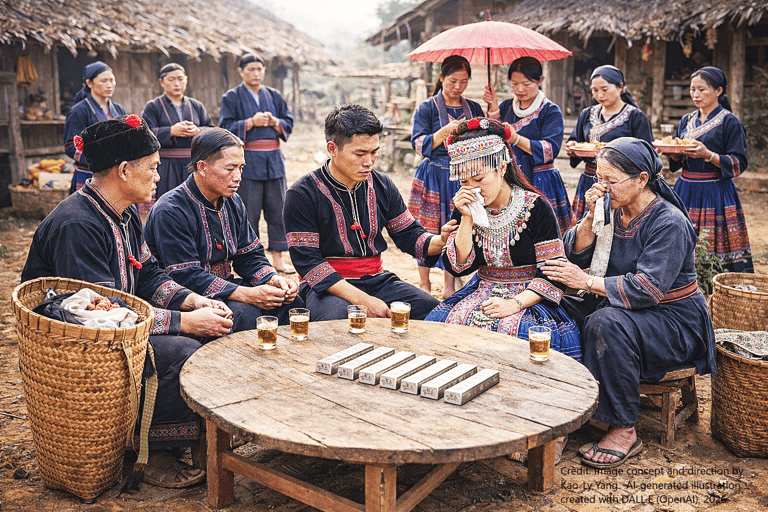
Traditional Hmong wedding ceremony in a rural village setting.
Seated around a table, mediators conduct the ritual proceedings. The bride, overcome with emotion as she prepares
to leave her natal family, sits beside her mother, who also grieves the transition,
as her departure is perceived as a social and spiritual rupture with her natal lineage.
The scene reflects the collective, intergenerational nature of Hmong marriage as a social contract
Linguistic Dimensions of the Bride Price
Several vernacular expressions illuminate its layered meanings:
Nqe tshoob — “wedding price”
Nqe taub hau — “price of the head”
Nqe mis nqe hno — “price of milk and meals”
The first two expressions are largely interchangeable, though nqe tshoob is preferred in formal discourse because it refers to the total wedding payment. Nqe taub hau more directly emphasizes the bride as a member of the household whose departure represents a loss.
The third expression, nqe mis nqe hno, refers specifically to repayment for nourishment—the milk and food provided during childhood. It addresses parental care and forms only one component of the overall bride price.
Linguistic analysis suggests that the bride price functions symbolically as repayment of the debt of upbringing and compensation for the loss of a daughter’s potential labor.
During wedding negotiations, elders often present the bride price as a form of warranty for the bride’s protection. Should she suffer abuse or injustice, she may be returned to her natal lineage, and the bride price reimbursed. Thus, beyond economics, it operates as a moral safeguard within customary law.
The Symbolic Role of the Bride Price in Social Exchange
The Exchange of Sisters
According to Claude Lévi-Strauss, a renowned French anthropologist, marriage is an institution in which groups exchange women—often sisters—across time. This premise is relevant to Hmong culture. As in many other patriarchal societies, Hmong lineages mobilize women within systems of social exchange.
Maintaining the Continuity of Social Relations
The goal of social exchange is to maintain continuity in relationships under all circumstances. In other words, there must be no interruption or rupture when transactions occur between individuals, households, lineages, or clans. This is precisely the case in marriages, which constitute a chain of social exchanges between different lineages.
What function does the bride price serve in this system? If a price were not paid for a bride, what would happen? The transaction would not be validated. The bride price thus functions as the binding element within the exchange that ensures continuity between the two groups. From the perspective of the bride’s lineage, the price compensates for the loss of a daughter. From the groom’s side, it counterbalances the taking of a daughter. Ultimately, the exchange satisfies each group’s prerogatives.
Through marriage, both lineages establish new social relationships that expand over time and may eventually reshape previous prerogatives, social contracts, agreements, and social order. This networking begins during the wedding itself, when members of both lineages acknowledge each other’s age, gender, and social status. For the Hmong, marriage marks the beginning of a new social order.
If one extends this analysis further, the bride price can also be understood as a moderating element that facilitates social communication. The bride’s lineage gives more—since it gives away a human being—while the groom’s lineage compensates temporarily with money, with the expectation of reciprocity in a different time, through the giving of a sister.
Overcoming the Unimaginable of Giving Away a Human Being
When a daughter marries, she—body and soul—fully integrates into her husband’s lineage. For example, upon her death, her soul cannot return to her natal lineage. This raises fundamental questions about how cultures negotiate human rights, gender equality, and the notion of personhood.
Can a sister or daughter be given away without considering her status as a human being with equal rights, even if such a practice appears normalized in patriarchal societies where women are perceived as objects of exchange? This tension is inherently contradictory. How does a culture resolve this contradiction and develop coherent practices to transcend it?
In Hmong culture, a symbolic value is attached to the bride price in order to overcome this tension. The bride price is not perceived as a financial payment equivalent to a human being, but rather as a promise of reciprocal exchange in accordance with Lévi-Strauss’s theoretical framework.
In sum, Hmong people define the bride price as a symbolic gift or debt, not as an equivalent to a human being—the true counterpart in the exchange. Nevertheless, it functions as symbolic capital, a social guarantee, or a moral instrument capable of mitigating the profound difficulty of giving away a human being—where one human being (the groom) provides a price in recognition of another human being (the bride).
In simple terms, the bride price serves to humanize the exchange. Within Hmong culture, women are not perceived as objects, but as human beings—daughters, wives, and mothers.
Socio-Cultural Criticism and Feminist Perspectives
Hmong people conceive of the bride price as an institution. Some believe it must change. Yet many feel it is necessary because it constitutes the core of social exchange and the foundation of Hmong culture. In the United States in the early 2000s, prominent Hmong women—well-known female leaders who advocated against domestic violence, supported gender equality, or led national organizations—still considered the practice of the bride price an essential element in maintaining Hmong culture, even though it might also contribute to inequality between men and women. Most accepted it as a custom, even if they did not believe it effectively maintained low divorce rates.
When this article was written in 2005, the bride price had risen as high as $50,000. The higher the bride’s level of education, the higher the bride price. Female medical doctors commanded tens of thousands of dollars. Ironically, one can understand why some men hesitated to marry highly educated women.
Why Do Hmong People Want to Maintain the Bride Price?
One major reason often given is that the bride price is closely tied to other cultural practices, such as marriage rituals and funeral ceremonies. Eliminating it could lead to the loss, disintegration, or incoherence of related traditions. Thus, preserving the bride price is perceived as preserving Hmong culture. However, from certain feminist perspectives, one may ask whether it is worthwhile to preserve practices that prevent half of the community—women—from enjoying equal rights and autonomy, leaving them dependent on fathers, brothers, or husbands.
There is no doubt that Hmong people seek to preserve their culture. However, Hmong communities in the diaspora must also adapt their practices to the legal and social frameworks of their adopted countries, whether in the United States or elsewhere. Slowly but surely, Hmong culture is evolving. Rather than viewing culture as rigid and permanently fixed, it may be more accurate to recognize it as the product of encounters, borrowings, and adaptations.
To ensure the transmission of core values embedded in cultural practices, more critical approaches are needed to reassess their relevance in preserving Hmong cultural heritage. Living in democratic societies where gender equality forms a foundational principle, the Hmong community must reexamine the soundness, suitability, and fairness of the bride price within its marriage practices. If women continue to be regarded as second-class citizens or minors in decision-making processes or professional advancement, they will be limited in contributing fully to the well-being of the community. As mothers, wives, and professionals, women are essential to the economic and sociocultural development of Hmong communities.
If one examines gender adaptation in diaspora contexts, there appears to be a reversal of social roles. Hmong women are often better prepared to meet the challenges of post-modern societies. Traditional socialization—emphasizing flexibility, adaptability, discipline, perseverance, and resilience—once intended to prepare women to integrate into a new lineage, has become a significant strength. Forms of feminine sociability have proven effective in enabling women to pursue professional careers, much as men exercise masculine sociability through leadership and creativity. Hmong women now contribute economically to their families while also sustaining and renewing Hmong culture and language. In such a context, is the bride price still necessary as a safeguard for women’s security? Women no longer occupy minor roles within diasporic family structures.
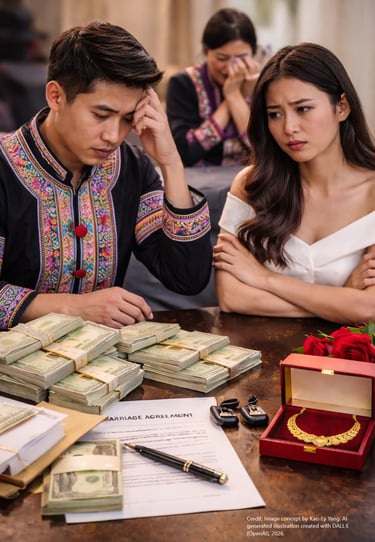
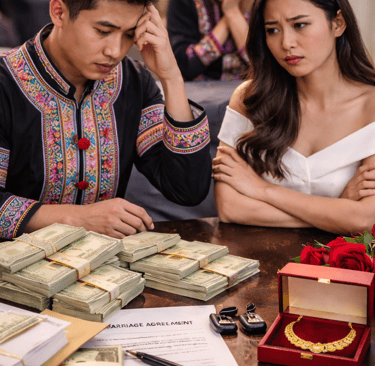
Modern reinterpretation of the Hmong bride price in a diasporic context.
A groom and a bride confront financial and emotional tensions surrounding bride price expectations. Visible symbols—cash, jewelry, legal documents—reflect the intersection of custom, modern economics, gender equality, and personal autonomy. The image highlights the complexities faced by younger generations navigating tradition within modern democratic societies.
Feminist Perspective
Until now, two primary perspectives—the internal Hmong cultural framework and anthropological theory—have been used to analyze the bride price. However, to develop a comprehensive understanding, one must also incorporate women’s perspectives, particularly feminist critiques, even if these viewpoints are not fully reconcilable. Such critique is relevant because interpretations of the bride price vary widely within the Hmong community, which is itself fragmented into subgroups with differing ideologies, lifestyles, and beliefs.
From a feminist standpoint, the bride price raises fundamental questions about the humanity of both genders. Should one assume the natural dominance of one gender over the other? Otherwise, the “second sex”—a term coined by Simone de Beauvoir to designate women—risks being reduced to an object of pleasure, deprived of subjectivity, desire, and agency. In simple terms, women would remain under social control and protection.
“[…] Anatomic destiny is thus profoundly different in man and woman, and no less different is their moral and social situation. Patriarchal civilization dedicated woman to chastity; it recognized more or less openly the right of the male to sexual freedom, while woman was restricted to marriage. The sexual act, if not sanctified by the code, by a sacrament, is for her a fault, a fall, a defeat, a weakness; she should defend her virtue, her honor; if she ‘yields’, if she ‘falls’, she is scorned; whereas any blame visited upon her conqueror is mixed with admiration. From primitive times to our own, intercourse has always been considered a “service” for which the male thanks the women by giving her presents or assuring her maintenance; but to serve is to give oneself a master; there is no reciprocity in this relation. The nature of marriage, as well as the existence of prostitutes, is the proof: woman gives herself, man pays her and takes her. Nothing forbids the male to act the master, to take inferior creatures." […], Beauvoir, 2011, p. 443–444.
Women possess humanity equal to that of men: they are subjects—not objects or commodities circulating within a deferred system of social exchange. In post-modern societies, the continued practice of the bride price may suggest that women are assimilated to exchangeable goods.
In contemporary contexts where women are as educated as men, the bride price may reinforce the perception of women as perpetual minors, lacking full decision-making authority and autonomy.
In societies governed by laws protecting against sexism and gender discrimination, why should women continue to require protection from fathers, brothers, or husbands? Should grooms pay high prices for highly educated brides? Hmong communities must preserve their culture—but they must also adapt.
****************************
Points of Discussion
POINT #1. The Bride Price and Early Marriages
The institution of the bride price cannot be fully understood without also examining its relationship to early marriage among Hmong women. Historically, marriage at a young age was embedded within a socio-economic system where daughters’ integration into another lineage secured alliances, labor distribution, and social continuity. In such a framework, the bride price functioned not only as compensation but also as validation of a girl’s readiness to assume adult responsibilities. Her young age would make her more manageable and submissive to her new husband’s lineage. However, in contemporary contexts—particularly in the diaspora—early marriage raises significant concerns regarding education, autonomy, and long-term economic independence for young women. When high bride prices intersect with expectations of early marriage, the practice may unintentionally reinforce gendered pressures that limit girls’ opportunities. Therefore, any critical reflection on the bride price must also address how marriage age, education, and women’s agency are negotiated within changing social, legal, and cultural environments.
When marriage occurs before full educational and personal autonomy is achieved, what becomes of the bride price?
POINT #2. The Bride Price and the Transmission of Culture
The bride price plays a significant role in the intergenerational transmission of Hmong culture. Marriage is not merely a union between two individuals; it is a structured encounter between lineages where rituals, oral traditions, kinship terminology, and customary law are enacted and taught. During negotiations, elders recite genealogies, rehearse moral expectations, and reaffirm clan histories, thereby transmitting collective memory to younger generations. The bride price ceremony becomes a pedagogical space where norms concerning respect, gender roles, reciprocity, and social responsibility are reinforced. In diasporic contexts, where cultural continuity faces pressure from assimilation, the bride price is often perceived as a stabilizing institution that anchors identity. However, the question remains whether cultural transmission depends on maintaining the financial dimension of the practice, or whether its symbolic and educational functions could endure through adapted forms.
If the financial dimension of the bride price were removed, could its symbolic and educational functions still ensure cultural transmission?
POINT #3. The Bride Price in Dialogue with Younger Generations
In recent decades, increasing numbers of young Hmong men and women—particularly in diasporic communities—have begun to question or openly reject the practice of the bride price. For many, the custom appears incompatible with modern values such as gender equality, romantic partnership, individual autonomy, and shared economic responsibility. Younger generations often perceive marriage primarily as a personal commitment between two individuals rather than as a contractual alliance between lineages. Additionally, the financial burden associated with high bride prices may delay marriage or create resentment, especially among young couples seeking educational and professional stability before forming a family. This generational shift reveals a broader transformation in the understanding of culture itself: rather than inheriting traditions unquestioned, younger Hmong actively reinterpret, negotiate, or selectively retain practices. The debate over the bride price thus becomes a site of intergenerational dialogue, conflict, and potential cultural renewal.
When marriage is redefined by younger generations as a partnership between individuals, what remains of the bride price?
POINT #4. Negotiating Tradition and Faith: The Bride Price in Christian Hmong Communities
The encounter between the bride price and Christianity introduces a new dimension to the ongoing transformation of Hmong marriage practices. In traditional Hmong cosmology, marriage is fundamentally a contract between lineages, spiritually and socially binding, and the bride price serves to formalize and legitimize that alliance. In Christian theology, however, marriage is primarily understood as a covenant between two individuals before God, grounded in mutual consent, spiritual equality, and moral commitment. This theological shift reorients the meaning of marriage from lineage-based exchange to personal covenant.
Within Christian Hmong communities, the bride price has been therefore subject to reinterpretation. Some believers question whether the practice resembles the purchase of a bride and whether it conflicts with Biblical teachings on the equal dignity of men and women. Others defend it as a cultural expression of gratitude toward parents rather than a transactional payment. In many churches, efforts have been made to reduce, standardize, or symbolically reinterpret the bride price in order to lessen financial burdens and avoid reinforcing gender inequality.
The negotiation between tradition and faith thus produces a dual framework of legitimacy: customary recognition by the clan and spiritual recognition by the church. Rather than abolishing the bride price outright, Christian Hmong communities often adapt its meaning, transforming it from an instrument of exchange into a symbolic gesture compatible with contemporary religious convictions.
When marriage shifts from a contract between lineages to a covenant before God, what becomes of the bride price?
POINT #5. Bride Price and Interracial Marriages
Interracial marriage forces the bride price to reveal its deepest logic: once the clan system is absent, the distinction between what is structural and what is merely contextual becomes visible.
The rise of interracial marriages introduces new complexities into the practice of the Hmong bride price. Traditionally, the bride price functions within a shared system of kinship, clan structure, and customary expectations. Both families understand the symbolic logic of exchange, reciprocity, and lineage continuity. In interracial unions, however, this shared framework may not exist. Non-Hmong families may interpret the bride price as a financial transaction or even as the “purchase” of a bride, creating misunderstandings about its symbolic meaning.
For Hmong families, the question becomes whether the bride price should be maintained as a marker of cultural identity or adapted in response to differing cultural norms. In some cases, symbolic or reduced bride prices are negotiated to preserve tradition while avoiding cultural conflict. In others, the practice is waived entirely, particularly when legal, religious, or intercultural sensitivities are at stake.
Interracial marriages also challenge the clan-based logic underlying the bride price. Since non-Hmong spouses do not belong to a Hmong clan system, the reciprocal dimension of lineage exchange is disrupted. The practice thus shifts from inter-clan alliance to symbolic affirmation of heritage.
Rather than signaling cultural loss, these adaptations may represent a transformation of the bride price from a strictly structural institution into a conscious cultural choice. In this context, the bride price becomes less about exchange between lineages and more about negotiating identity, belonging, and continuity across cultural boundaries.
When the reciprocal exchange of sisters becomes impossible, what remains of the bride price?
REFERENCES
Beauvoir, S. de. (2011). The second sex (C. Borde & S. Malovany-Chevallier, Trans.). Vintage Books. (Original work published 1949)
Donnelly, N. D. (1994). Changing lives of refugee Hmong women. University of Washington Press.
Geddes, W. R. (1976). Migrants of the mountains: The cultural ecology of the Blue Miao (Hmong Njua) of Thailand. Clarendon Press.
Goody, J. (1973). Bridewealth and dowry in Africa and Eurasia. In J. Goody & S. J. Tambiah (Eds.), Bridewealth and dowry (pp. 1–58). Cambridge University Press.
Her, C. (2016). Interracial dating: Examining race preference attitudes in Hmong adults (Master’s thesis, St. Cloud State University).
Her, M., & Heu, C. P. (2003). Traditional Hmong concepts of wife beating. In K. E. Culhane-Pera, D. E. Vawter, P. Xiong, & B. Babbitt (Eds.), Healing by heart: Clinical and ethical case stories of Hmong families and Western providers (pp. 224–233). Vanderbilt University Press.
Lee, G. Y., & Tapp, N. (2010). Culture and customs of the Hmong. Greenwood.
Lévi-Strauss, C. (1969). The elementary structures of kinship (J. H. Bell, J. R. von Sturmer, & R. Needham, Trans.). Beacon Press. (Original work published 1949.)
Lor, M., & Bowers, B. J. (2018). Understanding Hmong elders’ perceptions of cultural traditions in the United States. Journal of Transcultural Nursing, 29(4), 343–351.
Ngô, T. (2016). The new way: Protestantism and the Hmong in Vietnam. University of Washington Press.
Rubin, G. (1975). The traffic in women: Notes on the “political economy” of sex. In R. R. Reiter (Ed.), Toward an anthropology of women (pp. 157–210). Monthly Review Press.
Schein, L. (2005). Marrying out of place: Hmong/Miao women across and beyond China. In N. Constable (Ed.), Cross-border marriages: Gender and mobility in transnational Asia (pp. 53–79). University of Pennsylvania Press.
Thao, P. (2006). Hmong women’s perspectives on marriage and family in the United States. Hmong Studies Journal, 7, 1–25.
Vang, C. Y., Nibbs, F., & Vang, M. (Eds.). (2016). Claiming place: On the agency of Hmong women. University of Minnesota Press.
Vang, P. D. V., & Her, P. (2014). Teenage marriage among Hmong American women. Journal of Human Behavior in the Social Environment, 24(2), 138–155.
Yang, K.-L. (1999). Naître et grandir: Les processus de socialisation de l’enfant en milieu hmong (Doctoral dissertation, Université de Provence, Aix-Marseille I, France).
Yang, P. (1997). An investigation of divorce related to Hmong American women (Master’s thesis, University of Wisconsin–Stout).
This text was re-edited with the assistance of an AI tool.
Copyrights © 2005-2026 Kao-Ly Yang.
All Rights Reserved.

© 2002-2026. Kao-Ly Yang. All Rights Reserved.