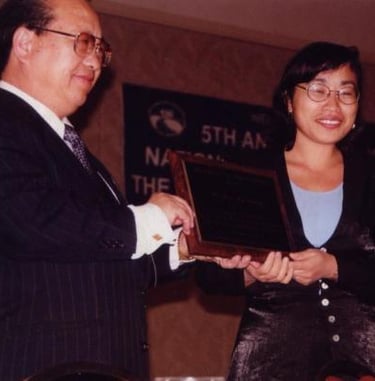
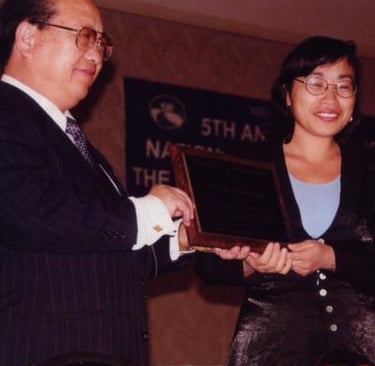
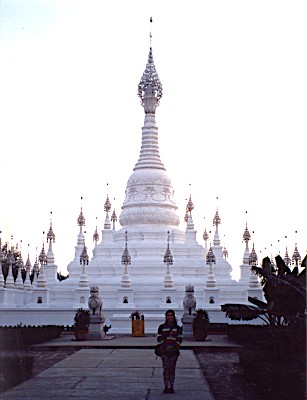
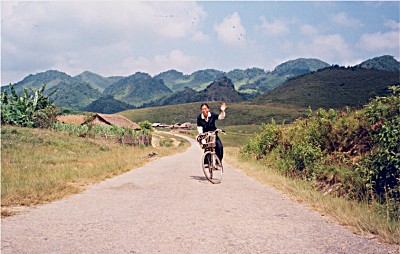

Kao-Ly Yang (Nkauj Hli Yaj) was born in Long Cheng in the beloved province of Xieng Khouang, Laos. As a child refugee, she went to France with her family in 1977 after spending more than two years in Ban Vinai, one of the refugee camps of Thailand.
In Laos, she attended some private pre-primary schools in Vientiane where French was taught before continuing in France from second grade to her doctorate of Anthropology at the University of Aix-Marseille I where she graduated in 1999 with Summa Cum Laude. She specialized in Socio-cultural and Medical Anthropology, Linguistics, Teaching of French and Hmong, and Hmong Studies.
During her first trip to Fresno in November 1999, CA, she was offered, on the second day of her arrival, a position of postgraduate researcher/project director at the University of California, San Francisco to conduct a research on the "Quality of Care" for Hmong patients with hypertension -- project founded by the National Institute of Health. Since then, she has been residing in Fresno where she pursues her research on Hmong cultural and religious changes, and on the teaching of Hmong language, culture and literature while earning her living as a French and Hmong instructor at Fresno City College and California State University, Fresno. Since 2012, she has been coordinating the Hmong program (since fall 2016, with its minor) at Fresno State. She also created the Hmong Voices Series at Fresno State in 2017 where she promotes the Hmong Studies at the same time gives opportunities to researchers, especially the young ones, personalities and artists to host or present their work or studies of the Hmong culture, history, literature, arts, and other issues.
With the years passing, the two most important contributions that Kao-Ly Yang did for the Hmong Studies -- and Hmong community-- are the saving of Father Yves Bertrais' archives in 2004, and the creation of the Hmong Minor, first Hmong Language program at California State University, Fresno in 2016.
At the end of 2003, Kao-Ly stopped working. She needed to reflect on her professional life, and took a "deep breath" before deciding to totally immerge for some long years in the pursuite of the study of Hmong people in North America. She then went to Thailand, and discovered Father Yves Bertrais' life work and archives. Become aware of the importance of his archives for the Hmong community and research on the invention of the Hmong written traditions, even if with little income, she traveled twice to Thailand to make the deposit of his archives possible at the University of Wisconsin-Madison in 2004-2005.
She made sure the whole archives were not divided in several places so that scholars will find them in the one place in order to advance the study of Hmong people during this period of the 20th century.
For the Hmong minor, intensively from 2012 to 2016, she made use of her 25 years of experience of research and teaching of languages, cultures, literature to write eleven textbooks to enhance the teaching quality of Hmong -- Two of them are published (See the webpage).
Kao-Ly Yang, still part-time faculty, made the choice to not apply for any tenure-track positions in order for her to remain in Fresno to push for a Hmong minor that would greatly benefit the Hmong Fresno community. In her mind, she selflessly thought: "A Hmong program with a minor is far essential than my own career and life. When I depart, this program with a minor will still exist for hundreds years to come, and will provide opportunities for the Hmong generations Worldwide to come to learn about their culture, language and history." The Hmong culture has a rich tradition of literature old of several thousand years: she believes that the Hmong language remains a tool of knowledge capable to capture the human experiences, and to express them in a language of shapes, of sounds and of accuracy. Also, to encourage students to learn Hmong, the cost of the textbooks stays very low.
As an indigenous anthropologist, Hmong, and former refugee who had exprienced so many losses, she believes that in order to preserve a culture or adapt it to new lifestyles, one needs to study it, to understand its challenges and stakes, and to teach it with its very own language because live in the Hmong language, humanistic values, tolerant concepts, inclusive symbols, ..., that may not be promoted in the current social practices. Since 1991, she has devoted her life to the study of the Hmong language, culture, and literature. Her choice to finally specialize in Hmong studies when pursuing in graduate studies came from a personal awakening, mainly due to her in-depth understanding and admiration of the Hmong people's skills and determination, otherwise inner strenght to survive wars, genocides, to overcome the fear of losing their language and culture, and to constantly adapt and reinvent their identity despite all tragic migrations for the past 4000 years. To sharpen her courage to undertake projects, her motto is: "It is not who you are that matters most, it is what you do for others."
Dr. Kao-Ly Yang is the owner of this website, The Hmong Contemporary Issues, created in 2002 in Fresno, CA.